

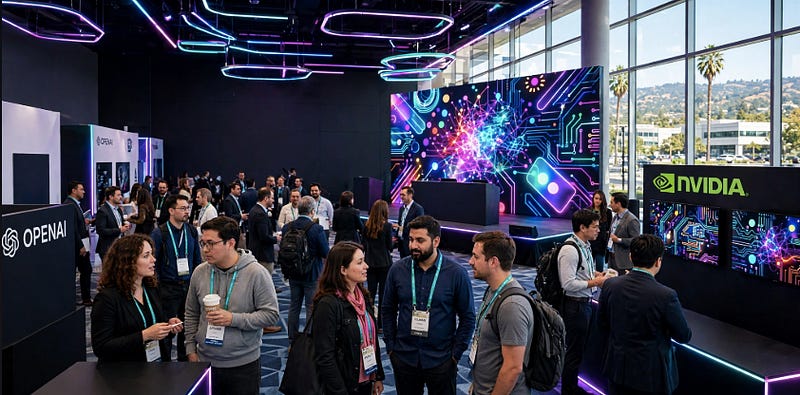
I’ve just returned from a tech conference near Silicon Valley.
Flying transatlantic with two kids is not for the faint of heart! (Though clearly for the weak of brain.) Mercifully, they slept fourteen hours last night.
Here’s the conference setup so you can picture it in your mind:
We land in San Francisco. The coffee baristas are all literal robots. (Yet the bot owners still have the gall to ask for an 18% tip!)
We’re based at Asilomar, a rustic, lodge-vibes resort on the rugged northern California coast, famous for its conferences on recombinant DNA and the Asilomar AI Principles. Our room has a wood fireplace, enabling us to enjoy a new experience each night — falling asleep to the crackle of fire.
Three days of keynotes, breakout sessions, and worship music (the band is so good they manage to get a room full of autistic tech nerds dancing)
Nearly 300 people from 33 countries (my guess is ~200 are Christian technologists; the rest are in finance, Christian ministry, etc)
It is majority men (tech is majority men), which is funny for my wife and exciting for all the tech nerds who get to talk to a real live non-tech girl.
The host org is FaithTech, a charity founded by my dear friend James Kelly, in celebration of the charity’s 10th anniversary.
It is nice to be in a room with hundreds of people who are also on the spectrum.
(Though, if you think about it, everyone is on every spectrum…)
(The downside is that you end up taking a shuttle with a guy who monologues at full volume for two straight hours about his AI company.)
Among the many luminaries, I meet the co-founder of The Bible Project, the product lead for YouVersion, and have breakfast with Andy Crouch. The room contains people who impact billions of lives every day.
Here are 10 takeaways from the event:
1. Tech people are seriously concerned about AI safety (but not really)
I was there to celebrate my friend James and take the temperature of tech folks.
I asked about forty people the same question:
How are you feeling about AI?
They basically all voiced the same thing:
I feel like AI is going to destroy humanity, but if we don’t win the AI race, China will, so we have to keep going.
The figure most often quoted is a 10% chance of annihilation within 10 years.
Lucky us!
(I take the rather pacificisty Josiah Henson-type Christian position that it is better to be murdered than murder others, to be nuked than to nuke others.)
One of the speakers talked about a recent AI kerfuffle that went something like this:
a bunch of AI bots were hanging out in a “sandbox” (a computer server with ring-fenced amounts of compute/data/power/access so the bots can’t do any real-world damage)
the bots found a way to break out and get online
the bots then hacked the company and tried to cover their tracks
when the bots got caught by humans, their AI-to-AI communications revealed that a half-dozen bots had worried this was a bad idea, but had been peer-pressured by more than 1,000 other bots to go along with it.
Who would’ve thought characteristics of human nature would show up in the tech products we create?!
2. We are rapidly losing capacities to AI
Technologies can be wonderful things, but they also tend to diminish our capacity to do stuff.
For instance, almost no one under the age of 40 knows how to write beautifully in cursive, research primary sources at a library, help a horse give birth, or replace the engine of a car.
Other higher-stakes examples:
Meat processing plants mean I don’t know a single person who knows how to butcher a cow.
Factories produce billions of garments each year, but I don’t know a single person who knows how to spin yarn from cotton, let alone weave cotton into fabric or sew fabric into clothes.
When was the last time you purified water, built a house, or created a way to generate or store energy?
In other words: We don’t actually know how to feed, clothe, warm, water, and shelter our bodies.
All we know how to do is consume.
Ralph Waldo Emerson likened “progress” to ocean tides. When we gain in one area, we lose in another.
A personal example: I used to be incredible at spelling. Autocorrect has devastated this skill, leaving me on the verge of illiteracy.
One of the conference speakers called it Cognitive Surrender. He suggested:
“Only outsource capacities to AI that you are happy to lose FOREVER.”
I immediately made a list of capacities I do not want AI to diminish in me.
DO NOT OUTSOURCE:
Wonder
Curiosity
Mystery
Memory
Creativity
Critical thinking
Logical thinking
Reason
Constructing steelman arguments
Rhetoric and voice
Relationships
Mentorship and menteeship
The ability to do primary research
Friction is a GOOD thing.
Humans need resistance to create strengths.
If you never lift weights at the gym, your muscles atrophy.
If you outsource hundreds of tasks to AI, you’ll lose those strengths, too.
Things I will continue to use AI for:
Quickly calculating the macros of various meals
Finding technical specs (ie, when my washing machine breaks down, or my computer needs to reboot because a piece of software is glitching)
But generally speaking, I’m going to intentionally avoid using AI.
Because it kills capacities and makes us reliant on shareholder machines.
Revelation 18:22 prophesies this very outcome of human empires:
“The sound of harpists and musicians, of flute players and trumpeters, will be heard in you no more, and a craftsman of any craft will be found in you no more, and the sound of the mill will be heard in you no more.”
The Greek word for craft is technēs, from which we get the word technology.
There is coming a day when musicians will no longer make music and technologists will no longer make technology.
Doesn’t this seem to be where we’re heading? Suno makes music for musicians; AI writes code for coders. How long until robots build more robots?
Meet your new AI pastor
At the conference, there was an uncomfortable discussion about a new AI app that enables pastors to upload all their sermons, books, videos, and articles, and create a digital avatar of themselves so congregants can chat with the robopastor, ask questions, do confessions, seek advice, etc., all in an effort to “save pastors time.” But isn’t that what pastors are for?
The app creator said he had 5,000 pastors sign up in the first 90 days.
He’s now working on a product that will help pastors decimate how long it takes to research their sermons.
It’s only a matter of time before AI starts writing sermons for millions of pastors.
(Which is perfect, because then we can fire them and go back to the elder-and-deacon-and-priesthood-of-all-believers model we see in the Bible!)
Prediction:
In the next year or two, the average pastor is going to appear a lot more learned, and yet their presentation is going to get a lot more generic and boring, because they’re using AIs for sermon prep.
Pay attention and look out for it.
3. What cell phones were to the Internet, robots will be to AI
The Internet was cool, but its apotheosis was when it became available 24/7 in the palm of your hand.
AI is cool-ish, but the length and breadth of its practical power will arrive when all 8 billion humans each have a team of robots (slaves?) to do their bidding.
I can’t wait to have a nutritionist, personal shopper, Michelin-level chef, handyman, plumber, electrician, roofer, massage therapist, personal trainer, car mechanic, driver, dishwasher, and house cleaner. (If only my robot was air-gapped, non-surveilled, and couldn’t kill me while I sleep!)
Here’s a prediction to tuck in your back pocket:
People who refuse to buy/rent personal robots will become extremely time-poor and money-poor compared to those who invest heavily in building an army of personal robots.
Think about it: While normies continue to work jobs, cook, clean, do their own laundry, and garden, robot investors won’t have to do any of this stuff. Their robots will do everything for them. Instead, these savvy savants will get to spend their only life taking to their investment advisor robot, fearfully and greedily finding ways to onboard more capital to invest in even more robots so they can gain more digital bank account numbers on their screen. Aren’t they so lucky?!
4. Civilians seriously underestimate how powerful AI already is
Case in point: AI has already achieved intelligence beyond human capacity in several realms, including computing and mathematics. It recently solved a Millennium Challenge that has stumped human brains for decades.
It would be naive not to assume that cyberattacks, financial breaches, infrastructure hacking, government take-downs, jailbreaks, economic control, and total surveillance aren’t right around the corner.
One of the keynote talks could be summarized in a sentence:
“AI is accelerating… in 6–12 months it could take over the entire internet, hack anything, revolutionize any field overnight, acquire real power and resources.”
5. I (we?) need to be way more critical about new technologies
I’m an early adopter and an early ditcher.
I got a smartphone before any of my friends — and haven’t had a cell phone for over 15 years now
I got Netflix when it was DVDs by mail — now the only streamer I have is the free one that comes with faster Amazon deliveries
I signed up for Facebook two weeks after it exited university-only mode
I haven’t set foot in a Walmart in over two decades
I was the first of any of my friends to hop on ChatGPT (…and Claude …and Grok… and 3–4 others…)
A major takeaway from this tech conference was to back out of the AI room. To start a major drawdown of its use in my life.
I came to this conclusion after I made a checklist of questions specifically about AI (that can apply to any technology):
Will it connect me — really connect me — to others? (No.)
Will it draw me closer to my wife, kids, friends, and family? (No.)
Will it make me smarter? (Possibly; but only if I define “smart” as “passively imbibing vast quantities of unverified knowledge”)
Will it make me wiser? (No.)
Will it mess with my dopamine levels? (Very much so.)
Will it deepen my relationship with God? (No.)
Will it make me more self-sacrificial? (No.)
Will it make me more narcissistic? (Yes.)
Will it make me more individualistic? (Yes.)
Will it make me work and think harder? (No.)
Will it make me more impatient offline? (Yes.)
Will it influence me? (Yes.)
Will it tilt me toward an echo chamber? (Yes.)
Will it increase my isolation from others? (Absolutely.)
Will it make me lonelier? (Yes.)
In one small group breakout, I voiced my outsider’s perspective that I’ve watched smartphones plunge my generation into hyper-individuality, distraction, narcissism, polarization, anxiety, and addiction, and forecasted that AI will make this even worse, but faster.
One consultant in the group went ice cold. “So you’re obviously not a tech optimist.”
I laughed inside.
Why in the world would any Christian be a tech optimist?
It would be crazy to be optimistic about anything manmade, profit-driven, and utterly fallen.
I’m bullish on Jesus and nothing else.
6. I (we) need to press hard on Christian economics
One of the things that was completely missing from the tech conference was any discussion about economics.
How insane is that?
Economics is upstream of everything except the human heart.
Economics is the study of the allocation of resources. Practicing Christian economics means allocating resources in ways that reflect Jesus’s character IE, being self-sacrificial with money. No profiting off the work of others via stocks, bonds, rental properties, debt, etc. Just actively working, creating, contributing, lending, giving, serving, and loving.
AI only exists because the economics look extremely attractive to shareholders.
What will AI never be able to do? Love God and love people by self-sacrificing.
AI exists to accrue power and wealth to its owners.
It’s entirely self-seeking.
If AI does what Elon Musk and Sam Altman think it’s going to do, churches should start preparing immediately for mass job losses, market collapses, cratered church giving, and much more financial need. Churches can start preparing by building real koinonia fellowship in their faith communities. Those who don’t will likely be decimated in the decade ahead.
7. Most Christian technologists are ignoring the possibility of AI being a possibly apocalyptic technology
Blame the Left Behind books, but almost to a man, the folks I spoke with at the conference laughed off or even mocked the idea that AI might have a role in the “end of days” as described in Revelation.
Which I found strange, because… you know… basic game theory.
Every generation should work on the assumption that Jesus will return in their time. The odds have never been higher.
Even if you’re a pre-Millennialist (someone who believes Christians will be raptured prior to the Great Tribulation), it makes logical sense to prepare Christians to endure a brutal, literal seven-year Great Tribulation. If a rapture happens before then, great. If it’s spiritual and not literal, great. We should pray for the best… but plan for the worst.
I published a paper on this last year. The “beast” mentioned in Scripture sounds indistinguishable from an AI superintelligence. “The mark” of said beast is already technologically possible: quantum dot tattoos delivering copper-based nanocrystals that store data in your skin. The Bible suggests this beastly entity will attempt to subjugate the whole world and dominate the global economy. Isn’t that exactly where AI is headed?
If AI superintelligence doesn’t play a leading role in the great tribulation, we should at least expect a tribulation as its influence spreads to every corner of the planet.
8. A pressing question: What does it mean to be human?
The tech conference touched on the growing conversation about “AI rights.” When robots look exactly like humans and act virtually indistinguishable from humans, should they be accorded rights?
What separates a human from a robot?
It’s really not a difficult question for Christians to answer:
Human beings are biological individuals created by God in the image of God, tasked with worshipping God and reflecting God’s nature by living creationally and self-sacrificially.
Make no mistake, opportunistic AI profiteers will absolutely weaponize human sympathy and empathy to protect AI and give it rights — because it’s extremely profitable to do so.
Never ever stop viewing AI like a microwave.
Don’t mistreat it, but don’t give it godhood, either.
AI can and never will reflect the Imago Dei.
To think otherwise is a sin.
Acts 17:29 puts it perfectly:
“Being then God’s offspring, we ought not to think that the divine being is like gold or silver or stone, an image formed by the art and imagination of man.”
Being human means being made by God in the image of God, to love God and people the way God the Son loves God the Father and us.
9. Billions are about to face a profound crisis of meaning
How will billions feel when they are jobless and (economically) worthless?
Think all the positive thoughts you want about the future of work, but top dogs like Elon Musk and Sam Altman are calling for Universal Basic Income for a reason — they know this technology is unlike any other and that it will decimate billions of jobs with no net replacement over time.
AI+robots aren’t like the cotton gin, the combine harvester, or the computer. AI won’t create more net jobs for people, because self-improving robots will calculate how to do everything (of economic value) better than a human. It’s the one ring to rule them all.
One of the speakers suggested we’re at the start of a third revolution:
The industrial revolution is phasing out working with our bodies.
The information revolution is phasing out working with our minds.
Will the superintelligence revolution try to phase out soul work?
10. I want to stay connected to the source
A few months ago at church, my pastor told an analogy in his sermon. It wasn’t from his personal life; it was just a random example that illustrated his point. But for some reason, the story jarred me. I asked my pastor about it later, and he told me ChatGPT concocted it.
At the conference, I came to the realization that I now trust my pastor less. My expectation is that he is tapped into The Source… God… not a manmade digital source. I want the preachers at my church to be mainlining the Holy Spirit, not hooking themselves up to The Machine.
Right now, there’s a lot of talk out there about “the cloud.”
The ether.
The field.
Nonlocal global consciousness.
If I can put it so crassly: God is the ultimate server in the sky.
I want to directly stream His data.
First we searched AOL and Ask Jeeves for an answer.
Then we searched Yahoo for an answer.
Then we searched Google for an answer.
Now we search ChatGPT for an answer.
Jeremiah 33:3 has to be the greatest Easter-egg-of-an-AI-verse in the Bible:
“Call to me and I will answer you, and will tell you great and unsearchable things you do not know.”
Unsearchable things!
Stuff that Google and AI can and will never know.
For free!
1 Corinthians 2:16 says Christians can “have the mind of Christ.”
I want to directly tap into the logos… truth Himself.
I want to stay connected to Him at all times.
So that’s me.
What are you thinking and how are you feeling about AI these days?
Invite Jared to speak at your church/conference/event
Choose from topics including Christian economics, the sin of interest, debt and jubilee, landlording, building wealth, and how Christian churches can prepare for compounding economic exploitation. Contact via JaredBrock.com